
Training and EASA Certification
Professional guidance for aviation specialists who want to build recognised competence and move towards EASA-oriented qualification.
We support candidates, technicians and aviation professionals with a clear understanding of training routes, certification requirements and practical qualification steps needed for professional development in the European aviation environment.
Our guidance is suitable for those who want to start their aviation pathway, strengthen technical knowledge, prepare for EASA-oriented standards and better understand how training connects with future career opportunities.
Baltic Aviation Training Registration Forms
Select the required registration form, fill in all mandatory fields, attach your personal ID/passport copy with photo and submit the application.
BASIC TRAINING CATEGORY B1.1 (AEROPLANES TURBINE)
BASIC TRAINING CATEGORY B1.3 (HELICOPTERS TURBINE)
BASIC TRAINING CATEGORY B2
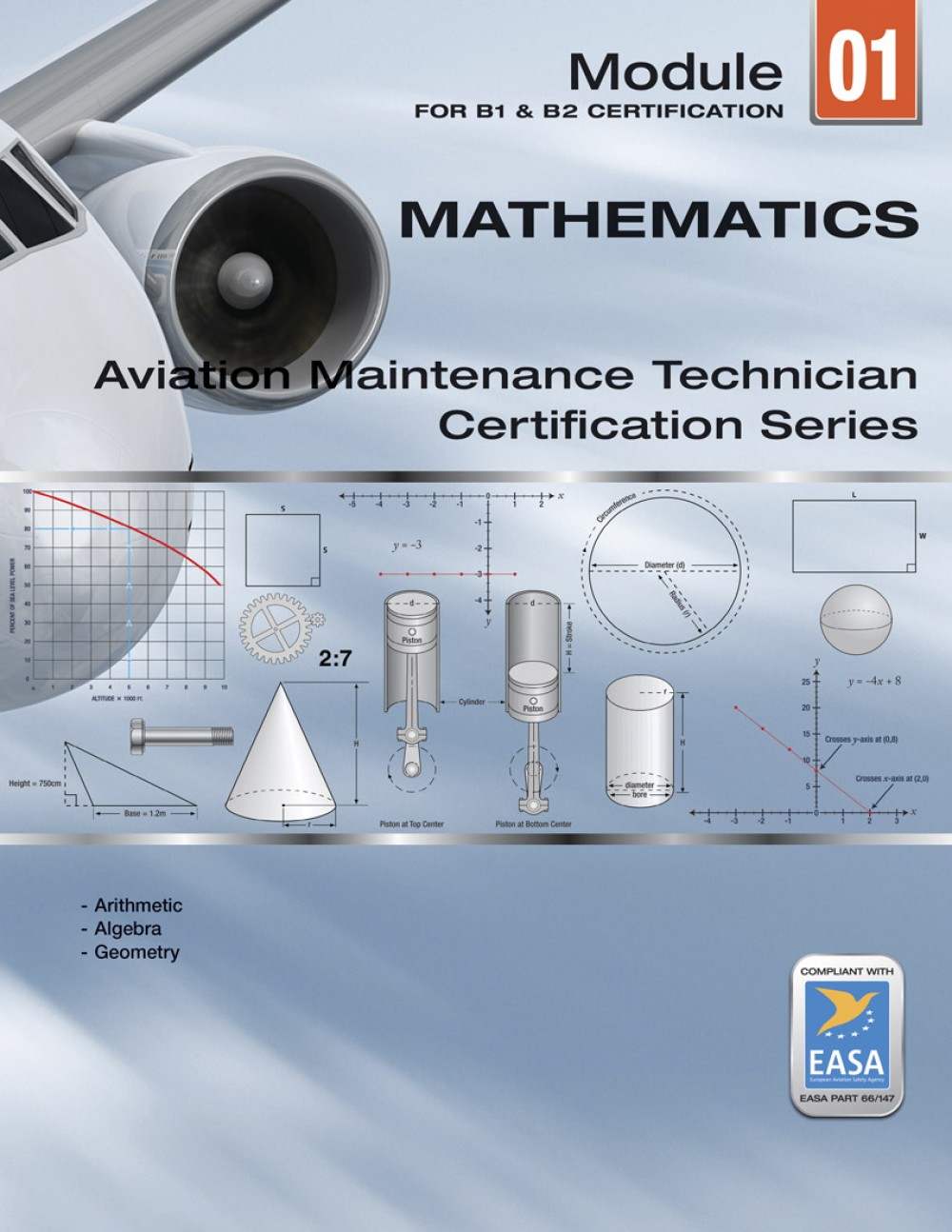
Module 1. Mathematics
The mathematics module, required for all licences, starts with very simple topics to build your confidence before moving on to more complicated topics of the syllabus.
The module covers 3 chapters: Arithmetic, Algebra and Geometry.
Although the chapters are quite large, they have been broken down to enable you to study a small section at a time.
This is an ideal module to begin studying for your licence as it will ease you into studying and build up your mathematical skills to meet any requirements in further modules.
Module 1. Mathematics(EASA Part-66)
Content
Arithmetic (B1 – level 2, B2 – level 2)
Arithmetical terms and signs, methods of multiplication and division, fractions and decimals, factors and multiples, weights, measures and conversion factors, ratio and proportion, averages and percentages, areas and volumes, squares, cubes, square and cube roots.
Algebra
- (a) Evaluating simple algebraic expressions, addition, subtraction, multiplication and division, use of brackets, simple algebraic fractions; (B1 – level 2, B2 – level 2)
- (b) Linear equations and their solutions; indices and powers, negative and fractional indices; binary and other applicable numbering systems; simultaneous equations and second degree equations with one unknown; logarithms. (B1 – level 1, B2 – level 1)
Geometry
- (a) Simple geometrical constructions; (B1 – level 1, B2 – level 1)
- (b) Graphical representation; nature and uses of graphs, graphs of equations/functions. (B1 – level 2, B2 – level 2)
- (c) Simple trigonometry; trigonometrical relationships, use of tables and rectangular and polar coordinates. (B1 – level 2, B2 – level 2)
Simple geometrical constructions; graphical representation; nature and uses of graphs; graphs of equations/functions; simple trigonometry; trigonometrical relationships, use of tables and rectangular and polar coordinates.
Practical Training: Yes
Examination: Yes
Essay: Yes
Module 2. Physics
The physics module is required for all licences and includes 5 chapters: matter, mechanics, thermodynamics, optics (light) and wave motion & sound.
The basic physics contained in this module is applied in more detail in more specialised modules.
As well as learning laws and equations, this involves applying maths to real life situations, making it the ideal companion, or follow-on, for the mathematics module.
ISBN: 9781906871017
Module 2. Physics (EASA Part-66)
Content
Matter (level 1)
Nature of matter: the chemical elements, structure of atoms, molecules; Chemical compounds; States: solid, liquid and gaseous; Changes between states.
Mechanics (level 2)
Statics
Forces, moments and couples, representation as vectors; Centre of gravity; Elements of theory of stress, strain and elasticity: tension, compression, shear and torsion; Nature and properties of solid, fluid and gas; Pressure and buoyancy in liquids (barometers).
Kinetics
Linear movement: uniform motion in a straight line, motion under constant acceleration (motion under gravity);
Rotational movement: uniform circular motion (centrifugal / centripetal forces);
Periodic motion: pendular movement; Simple theory of vibration, harmonics and resonance; Velocity ratio, mechanical advantage and efficiency.
Dynamics
Mass.
Force, inertia, work, power, energy (potential, kinetic and total energy), heat, efficiency.
Momentum, conservation of momentum; Impulse; Gyroscopic principles;
Friction: nature and effects, coefficient of friction (rolling resistance).
Fluid Dynamics
Specific gravity and density;
Viscosity, fluid resistance, effects of streamlining; Effects of compressibility on fluids; Static, dynamic and total pressure: Bernoulli's Theorem, venturi.
Thermodynamics (level 2)
Temperature: thermometers and temperature scales: Celsius, Fahrenheit and Kelvin; Heat definition;
Heat capacity, specific heat;
Heat transfer: convection, radiation and conduction; Volumetric expansion; First and second law of thermodynamics;
Gases: ideal gases laws; specific heat at constant volume and constant pressure, work done by expanding gas;
Isothermal, adiabatic expansion and compression, engine cycles, constant volume and constant pressure, refrigerators and heat pumps;
Latent heats of fusion and evaporation, thermal energy, heat of combustion.
Optics (Light) (level 2)
Nature of light; speed of light;
Laws of reflection and refraction: reflection at plane surfaces, reflection by spherical mirrors, refraction, lenses; Fibre optics.
Wave Motion and Sound (level 2)
Wave motion: mechanical waves, sinusoidal wave motion, interference phenomena, standing waves;
Sound: speed of sound, production of sound, intensity, pitch and quality, Doppler effect.
Practical Training: Yes
Examination: Yes
Essay: Yes
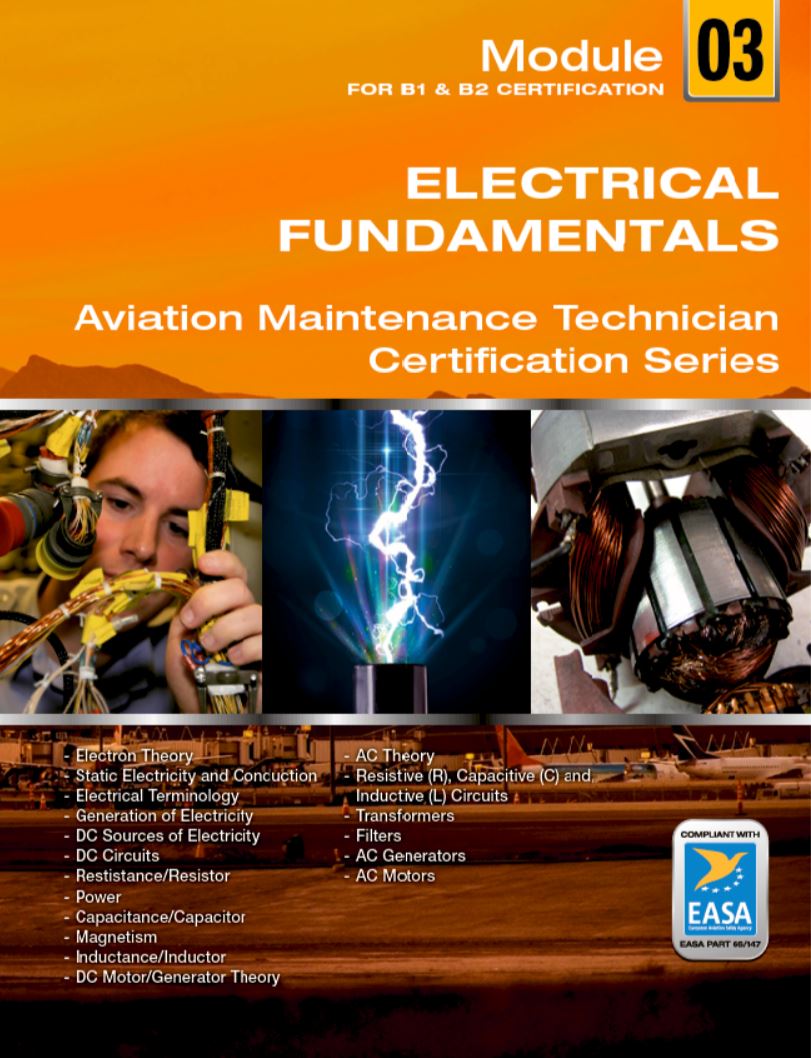
Module 3. Electrical Fundamentals
This module is required for all licences and is made up of 18 chapters.
Topics include generation of electricity, magnetism, generators, transformers and motors.
This module provides a basis for electrical modules required for the licence, especially for module 4: Electronic fundamentals.
Module 3. Electrical fundamentals (EASA Part-66)
📘Contents:
Electron Theory (level 1)
Structure and distribution of electrical charges within: atoms, molecules, ions, compounds; Molecular structure of conductors, semiconductors and insulators.
Static Electricity and Conduction (level 2)
Static electricity and distribution of electrostatic charges; Electrostatic laws of attraction and repulsion; Units of charge, Coulomb's Law; Conduction of electricity in solids, liquids, gases and a vacuum.
Electrical Terminology (level 2)
The following terms, their units and factors affecting them: potential difference, electromotive force, voltage, current, resistance, conductance, charge, conventional current flow, electron flow.
Generation of Electricity (level 1)
Production of electricity by the following methods: light, heat, friction, pressure, chemical action, magnetism and motion.
DC Sources of Electricity (level 2)
Construction and basic chemical action of: primary cells, secondary cells, lead acid cells, nickel cadmium cells, other alkaline cells; Cells connected in series and parallel; Internal resistance and its effect on a battery; Construction, materials and operation of thermocouples; Operation of photo-cells.
DC Circuits (level 2)
Ohms Law, Kirchoff's Voltage and Current Laws; Calculations using the above laws to find resistance, voltage and current; Significance of the internal resistance of a supply.
Resistance / Resistor (level 2)
Resistance and affecting factors; Specific resistance; Resistor colour code, values and tolerances, preferred values, wattage ratings; Resistors in series and parallel; Calculation of total resistance using series, parallel and series-parallel combinations; Operation and use of potentiometers and rheostats; Operation of Wheatstone Bridge.
Positive and negative temperature coefficient conductance; Fixed resistors, stability, tolerance and limitations, methods of construction; Variable resistors, thermistors, voltage dependent resistors; Construction of potentiometers and rheostats; Construction of Wheatstone Bridge.
Power (level 2)
Power, work and energy (kinetic and potential); Dissipation of power by a resistor; Power formula; Calculations involving power, work and energy.
Capacitance / Capacitor (level 2)
Operation and function of a capacitor; Factors affecting capacitance: area of plates, distance between plates, number of plates, dielectric and dielectric constant, working voltage, voltage rating; Capacitor types, construction and function; Capacitor colour coding; Calculations of capacitance and voltage in series and parallel circuits; Exponential charge and discharge of a capacitor, time constants; Testing of capacitors.
Magnetism (level 2)
Theory of magnetism; Properties of a magnet; Action of a magnet suspended in the Earth's magnetic field; Magnetisation and demagnetisation; Magnetic shielding; Various types of magnetic material; Electromagnets construction and principles of operation; Hand clasp rules to determine magnetic field around current carrying conductor.
Magnetomotive force, field strength, magnetic flux density, permeability, hysteresis loop, retentivity, coercive force, reluctance, saturation point, eddy currents; Precautions for care and storage of magnets.
Inductance / Inductor (level 2)
Faraday's Law; Action of inducing a voltage in a conductor moving in a magnetic field; Induction principles; Effects of magnetic field strength, rate of change of flux, number of conductor turns; Mutual induction; Lenz's Law; Back emf; Saturation point; Principle uses of inductors.
DC Motor / Generator Theory (level 2)
Basic motor and generator theory; Construction and operation of DC generators and motors; Factors affecting output, torque, speed and direction; Series, shunt and compound motors; Starter generator construction.
AC Theory (level 2)
Sinusoidal waveform: phase, period, frequency; Instantaneous, average, RMS, peak values; Triangular / square waves; Single / three-phase principles.
Resistive (R), Capacitive (C) and Inductive (L) Circuits (level 2)
Phase relationships; Power dissipation; Impedance, phase angle, power factor; True, apparent and reactive power calculations.
Transformers (level 2)
Construction, operation, losses, efficiency, polarity, voltage/current calculations; Auto transformers.
Filters (level 1)
Low pass, high pass, band pass, band stop filters.
AC Generators (level 2)
Operation and construction of AC generators; Single and three-phase systems; Star and delta connections; Permanent magnet generators.
AC Motors (level 2)
Construction and operation of synchronous and induction motors; Speed control; Rotating field methods.
⚒ Performance: Yes
📝 Exam: Yes
📄 Certificate: Yes
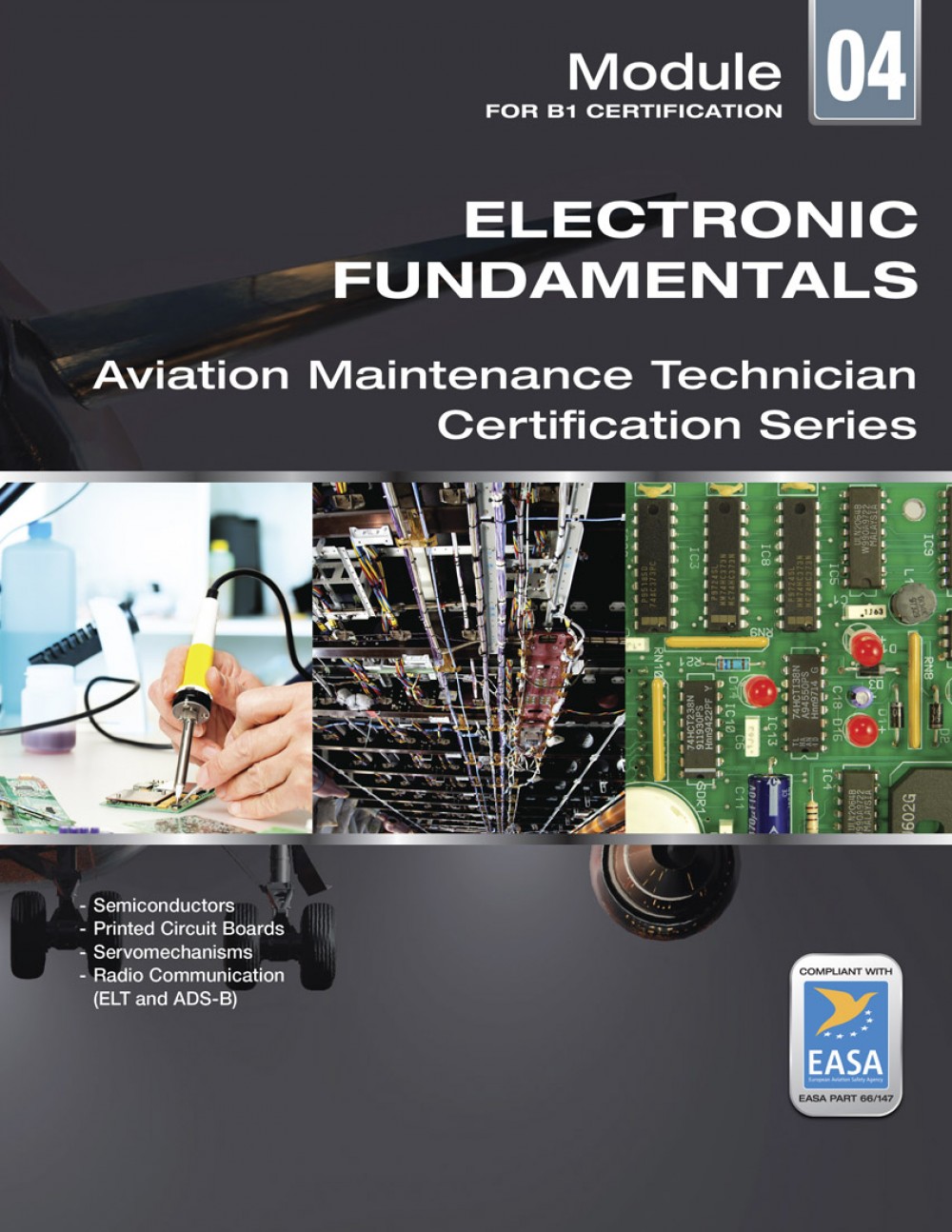
Module 4. (B1) Electronic Fundamentals
This module is required for B1 and B2 licences only.
It is made up of only 3 chapters: semiconductors, printed circuit boards and servomechanisms.
Although all chapters have to be studied for both B1 and B2, there is substantially more work for the B2 licence at a higher level than for B1.
This module provides an excellent follow-on from Module 3: Electrical fundamentals.
Module 4. Electronic fundamentals (EASA Part-66)
📘Contents:
Semiconductors
Diodes (level 2)
Diode symbols; Diode characteristics and properties; Diodes in series and parallel; Main characteristics and use of silicon controlled rectifiers (thyristors), light emitting diode, photo conductive diode, varistor, rectifier diodes; Functional testing of diodes.
Transistors (level 1)
Transistor symbols; Component description and orientation; Transistor characteristics and properties.
Integrated Circuits
Description and operation of logic circuits and linear circuits / operational amplifiers.
Printed Circuit Boards (level 1)
Description and use of printed circuit boards.
Servomechanisms (level 1)
Understanding of the following terms: Open and closed loop systems, feedback, follow up, analogue transducers; Principles of operation and use of the following synchro system components / features: resolvers, differential, control and torque, transformers, inductance and capacitance transmitters.
⚒ Performance: Yes
📝 Exam: Yes
📄 Certificate: Yes
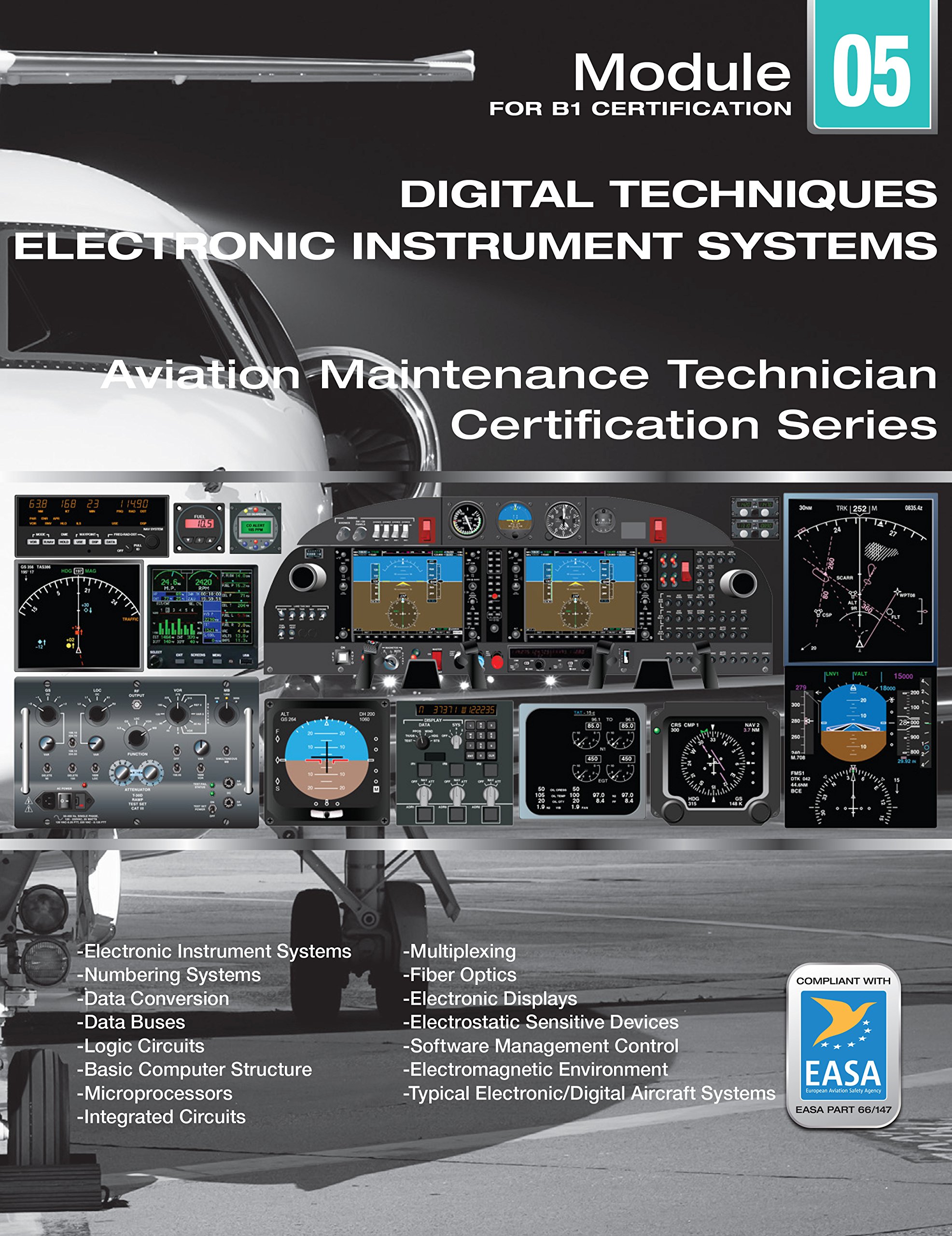
Module 5. Digital techniques / Electronic instrument systems
This module is required for all licences and is made up of 15 chapters, including electronic instrument systems, logic circuits, fibre optics and digital aircraft systems.
All the ‘behind the scenes’ work that goes on to make an instrument work is considered.
Knowledge of modules 3 & 4 electrical and electronic fundamentals would be useful before starting this module.
ISBN: 9781906871031
Module 5. Digital Techniques Electronic Instrument Systems (EASA Part-66)
📘Contents:
5.1. Electronic Instrument Systems (level 2)
Typical systems arrangements and cockpit layout of electronic instrument systems.
5.2. Numbering Systems (level 1)
Binary, octal and hexadecimal systems; conversions between decimal and binary, octal and hexadecimal systems and vice versa.
5.3. Data Conversion (level 1)
Analogue and digital data; operation and application of analogue to digital and digital to analogue converters, inputs and outputs, limitations.
5.4. Data Buses (level 2)
Operation of data buses in aircraft systems, including ARINC and other specifications; Aircraft Network / Ethernet.
5.5. Logic Circuits (level 2)
Identification of logic gate symbols, tables and equivalent circuits; applications in aircraft systems and schematic diagrams.
5.6. Basic Computer Structure (level 2)
Computer terminology (bit, byte, software, hardware, CPU, IC, RAM, ROM, PROM); computer technology in aircraft systems.
5.10. Fibre Optics (level 1)
Advantages and disadvantages of fibre optic transmission; fibre optic data bus; related terms; terminations; couplers; application in aircraft systems.
5.11. Electronic Displays (level 2)
Principles of operation of displays: CRT, LED and LCD.
5.12. Electrostatic Sensitive Devices (level 2)
Handling of ESD-sensitive components; risks, damage, and protection methods.
5.13. Software Management Control (level 2)
Restrictions, airworthiness requirements and risks of unapproved software changes.
5.14. Electromagnetic Environment (level 2)
Influence of EMC, EMI, HIRF and lightning on maintenance practices.
5.15. Typical Electronic / Digital Aircraft Systems (level 2)
- ACARS – Communication and Reporting System
- EICAS – Engine Indication and Crew Alerting System
- FBW – Fly by Wire
- FMS – Flight Management System
- IRS – Inertial Reference System
- ECAM – Electronic Centralized Aircraft Monitoring
- EFIS – Electronic Flight Instrument System
- GPS – Global Positioning System
- TCAS – Traffic Alert Collision Avoidance System
- Integrated Modular Avionics
- Cabin Systems
- Information Systems
⚒ Performance: Yes
📝 Exam: Yes
📄 Certificate: Yes
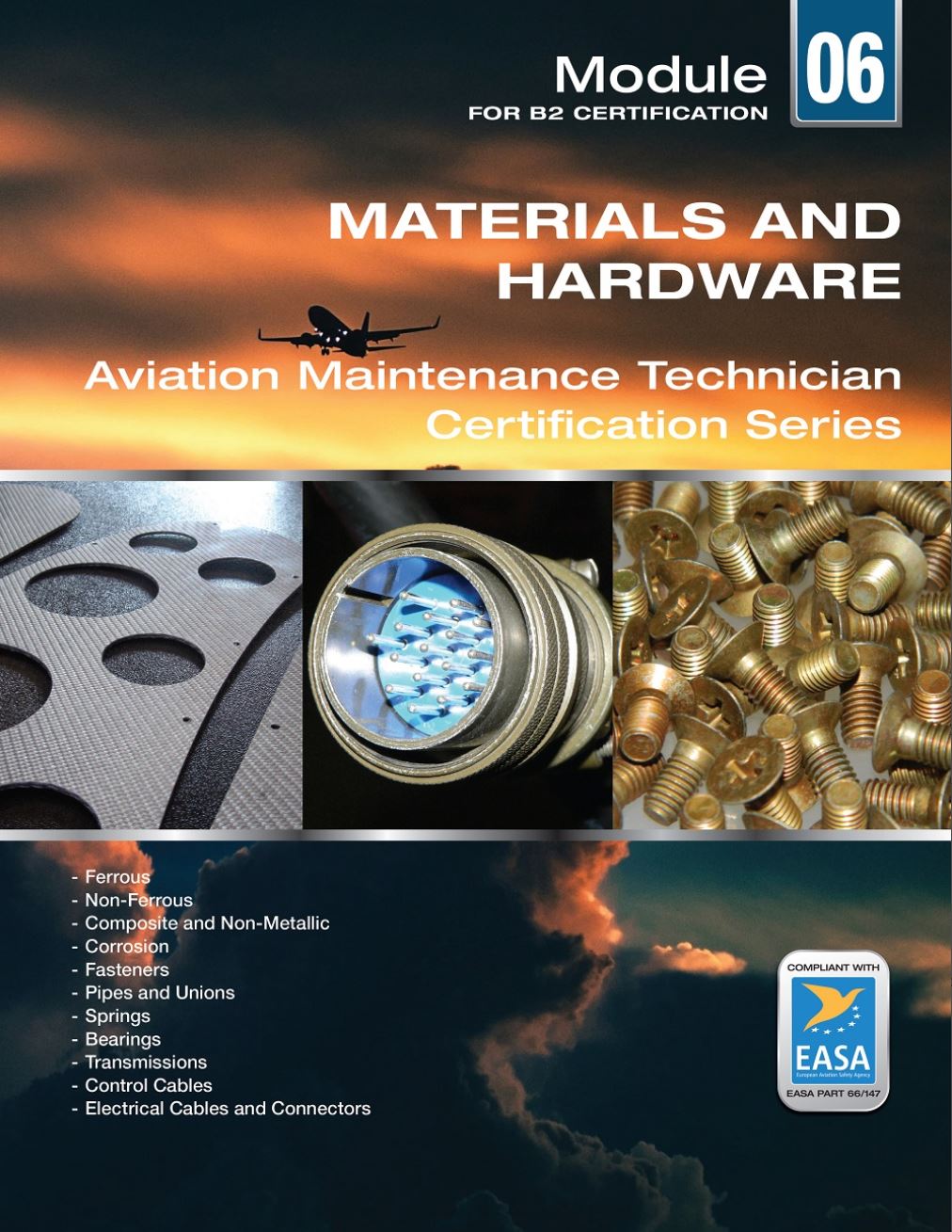
Module 6. Materials & Hardware
This module is required for all licences and is made up of 11 chapters, including aircraft materials, corrosion, fasteners, pipes, bearings and transmissions.
This module acts as a lead-in module for Module 7: Maintenance Practices.
Module 6 explains all components before they are used in Module 7.
Module 6. Materials & Hardware (EASA Part-66)
📘Contents:
6.1. Aircraft Materials — Ferrous
Characteristics, properties and identification of alloy steels; heat treatment and application; testing for hardness, tensile strength, fatigue strength and impact resistance.
6.2. Aircraft Materials — Non-Ferrous
Characteristics, properties and identification of non-ferrous materials; heat treatment and application; testing for hardness, tensile strength, fatigue strength and impact resistance.
6.3. Composite and Non-Metallic Materials
- Composite and non-metallic materials, sealants and bonding agents
- Defect detection and repair of composite materials
- Wooden structures: construction, defects, maintenance and repair
- Fabric covering: properties, inspection and repair
6.4. Corrosion
Chemical fundamentals; types of corrosion, causes and identification; material susceptibility.
6.5. Fasteners
- Screw threads: nomenclature, dimensions, tolerances
- Bolts, studs and screws: types, identification and use
- Locking devices: washers, locking plates, pins, safety wiring
- Aircraft rivets: solid and blind rivets
6.6. Pipes and Unions
Types of rigid and flexible pipes; connectors; standard unions for aircraft systems.
6.7. Springs
Types, materials, characteristics and applications.
6.8. Bearings
Purpose, loads, construction and types of bearings.
6.9. Transmissions
Gear types, ratios, systems; belts, pulleys, chains and sprockets.
6.10. Control Cables
Types of cables, fittings, pulleys, systems and applications.
6.11. Electrical Cables and Connectors
Cable types, construction, characteristics; connectors, pins, plugs, identification and ratings.
⚒ Performance: Yes
📝 Exam: Yes
📄 Certificate: Yes
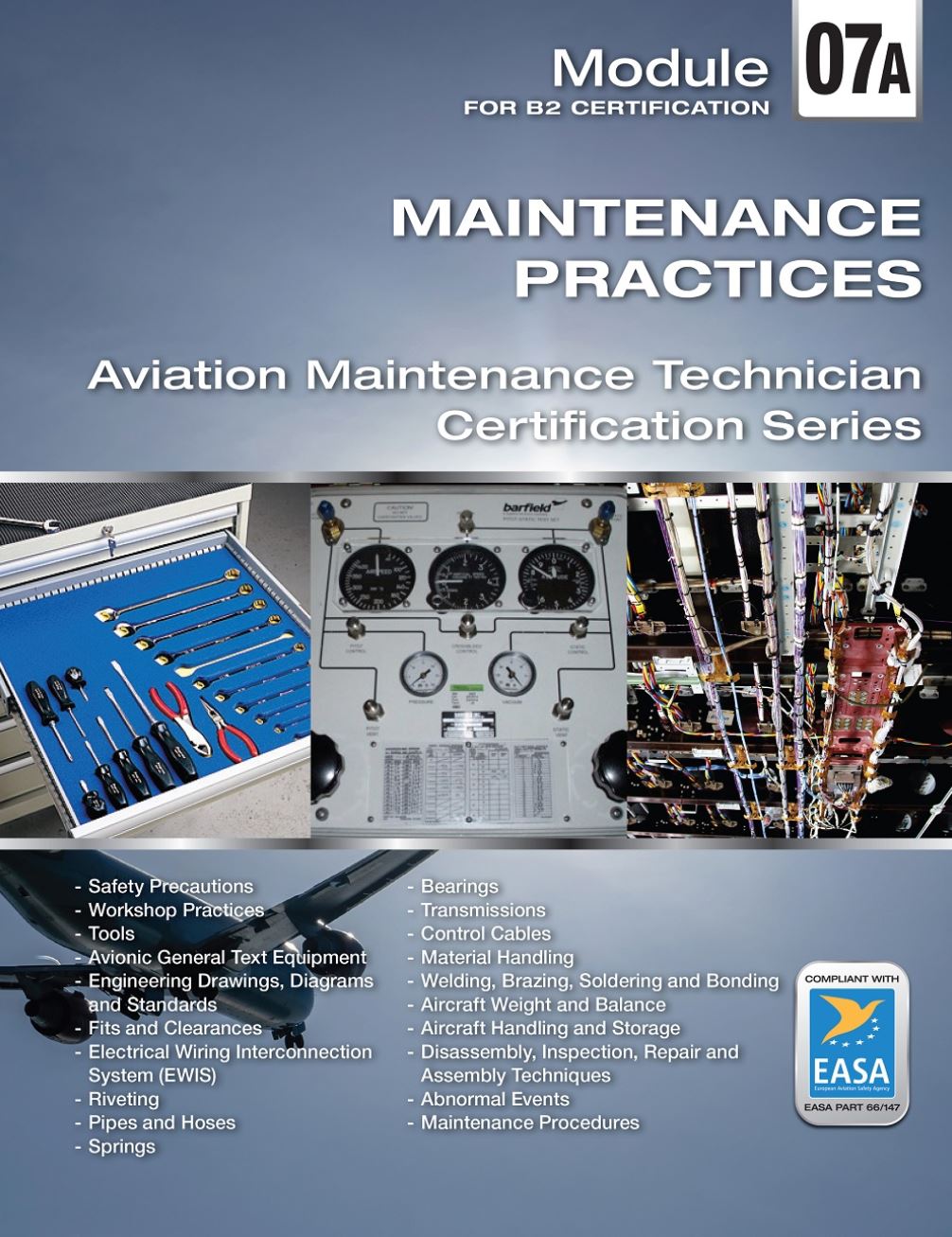
Module 7. Maintenance practices
This module is required for all licences and is made up of 20 chapters, including safety precautions, workshop practices, engineering standards, assembly, inspection and maintenance procedures.
Knowledge of Module 6: Materials & Hardware would be an advantage before beginning to study this module.
Module 7. Maintenance Practices (EASA Part-66)
📘Contents:
7.1. Safety Precautions (level 3)
Safe working practices; hazards with electricity, gases, oils and chemicals; fire response and extinguishing agents.
7.2. Workshop Practices (level 3)
Tool care and control; materials; tolerances and standards; calibration of tools and equipment.
7.3. Tools (level 3)
Hand and power tools; precision measuring tools; lubrication equipment; electrical test equipment.
7.4. Avionic Test Equipment (level 2)
Operation and use of avionic general test equipment.
7.5. Engineering Drawings and Standards (level 2)
Drawings, symbols, tolerances; ATA 100; ISO, AN, MS, NAS, MIL standards; wiring and schematic diagrams.
7.6. Fits and Clearances (level 2)
Fits, tolerances, drill sizes, shaft and bearing checks.
7.7. EWIS (level 3)
Wiring installation, testing, crimping, connectors, protection techniques, inspection and repair standards.
7.8. Riveting (level 2)
Riveted joints, tools and inspection.
7.9. Pipes and Hoses (level 2)
Installation, bending, inspection and testing.
7.10. Springs
Inspection and testing of springs.
7.11. Bearings (level 2)
Inspection, lubrication and defect analysis.
7.12. Transmissions (level 2)
Inspection of gears, belts, pulleys, chains and mechanical systems.
7.13. Control Cables (level 2)
Swaging, inspection, testing and system components.
7.14. Material Handling
- Sheet metal: marking, forming and inspection
- Composite materials: bonding and inspection
7.15. Welding, Brazing, Soldering and Bonding (level 2)
Methods and inspection of joints.
7.16. Aircraft Weight and Balance (level 2)
CG calculations; weighing procedures.
7.17. Aircraft Handling and Storage (level 2)
Taxiing, towing, jacking, fueling, de-icing, ground support systems and environmental effects.
7.18. Inspection and Repair Techniques
Defects, corrosion control, repair methods, NDT techniques, troubleshooting.
7.19. Abnormal Events (level 2)
Inspections after lightning, HIRF, heavy landings and turbulence.
7.20. Maintenance Procedures (level 2)
Planning, modifications, certification, quality control and life-limited components.
⚒ Performance: Yes
📝 Exam: Yes
📄 Certificate: Yes
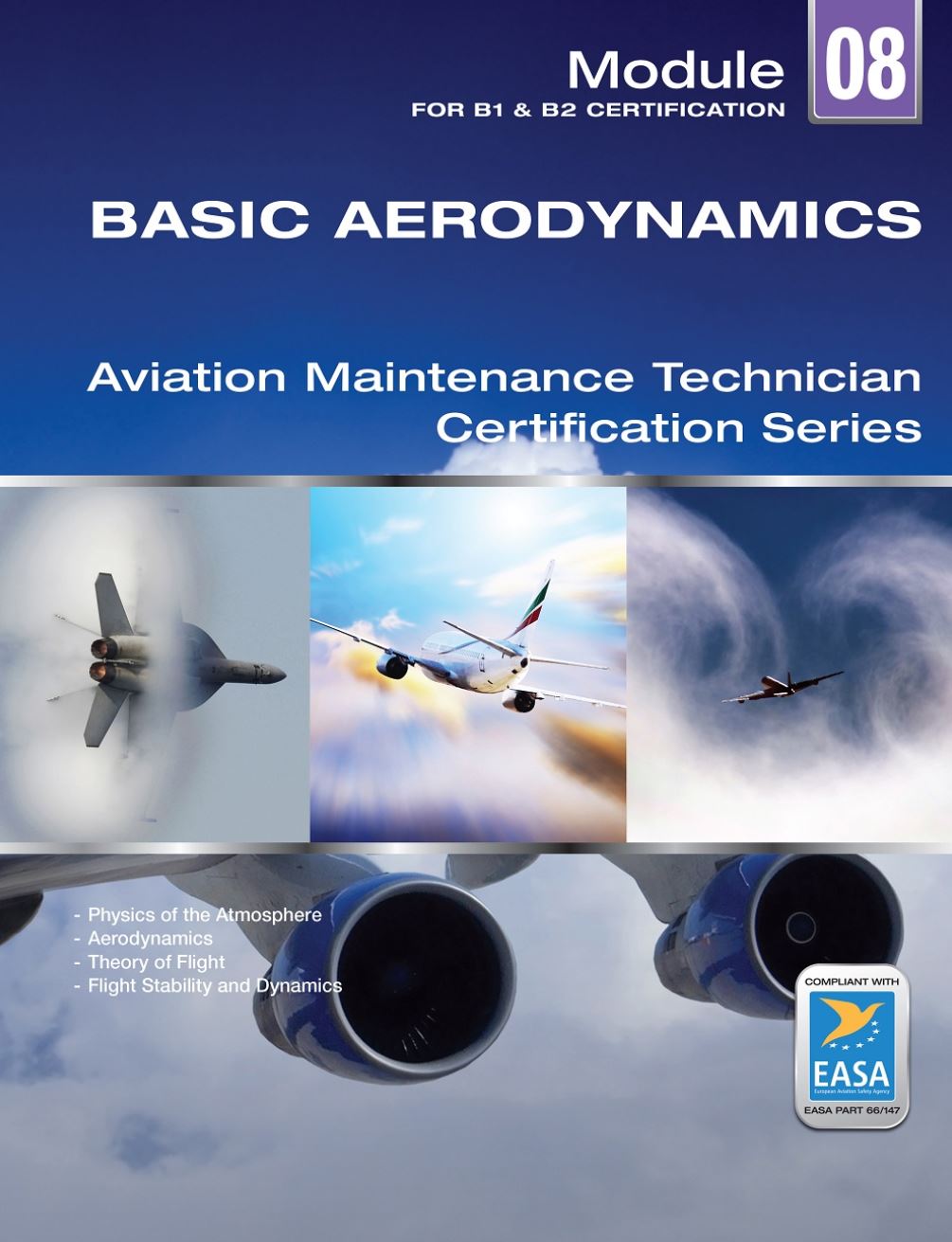
Module 8. Basic aerodynamics
This module is required for all licences and is made up of 4 chapters.
These are Physics of the Atmosphere, Aerodynamics, Theory of Flight and Flight Stability & Dynamics.
Studying Module 2: Physics before this module would be an advantage.
Module 8. Basic Aerodynamics (EASA Part-66)
📘Contents:
8.1. Physics of the Atmosphere (level 2)
International Standard Atmosphere (ISA), application to aerodynamics.
8.2. Aerodynamics (level 2)
Airflow around a body; boundary layer, laminar and turbulent flow, free stream flow, relative airflow, upwash and downwash, vortices, stagnation.
Camber, chord, mean aerodynamic chord, parasite drag, induced drag, centre of pressure, angle of attack, wash-in and wash-out, fineness ratio, wing shape and aspect ratio.
Thrust, weight, aerodynamic resultant; lift and drag generation; lift and drag coefficients; polar curve; stall; aerofoil contamination (ice, snow, frost).
8.3. Theory of Flight (level 2)
Relationship between lift, weight, thrust and drag; glide ratio; steady flight performance; theory of turn; load factor influence; flight envelope and structural limits; lift augmentation.
8.4. Flight Stability and Dynamics (level 2)
Longitudinal, lateral and directional stability (active and passive).
⚒ Performance: Yes
📝 Exam: Yes
📄 Certificate: Yes
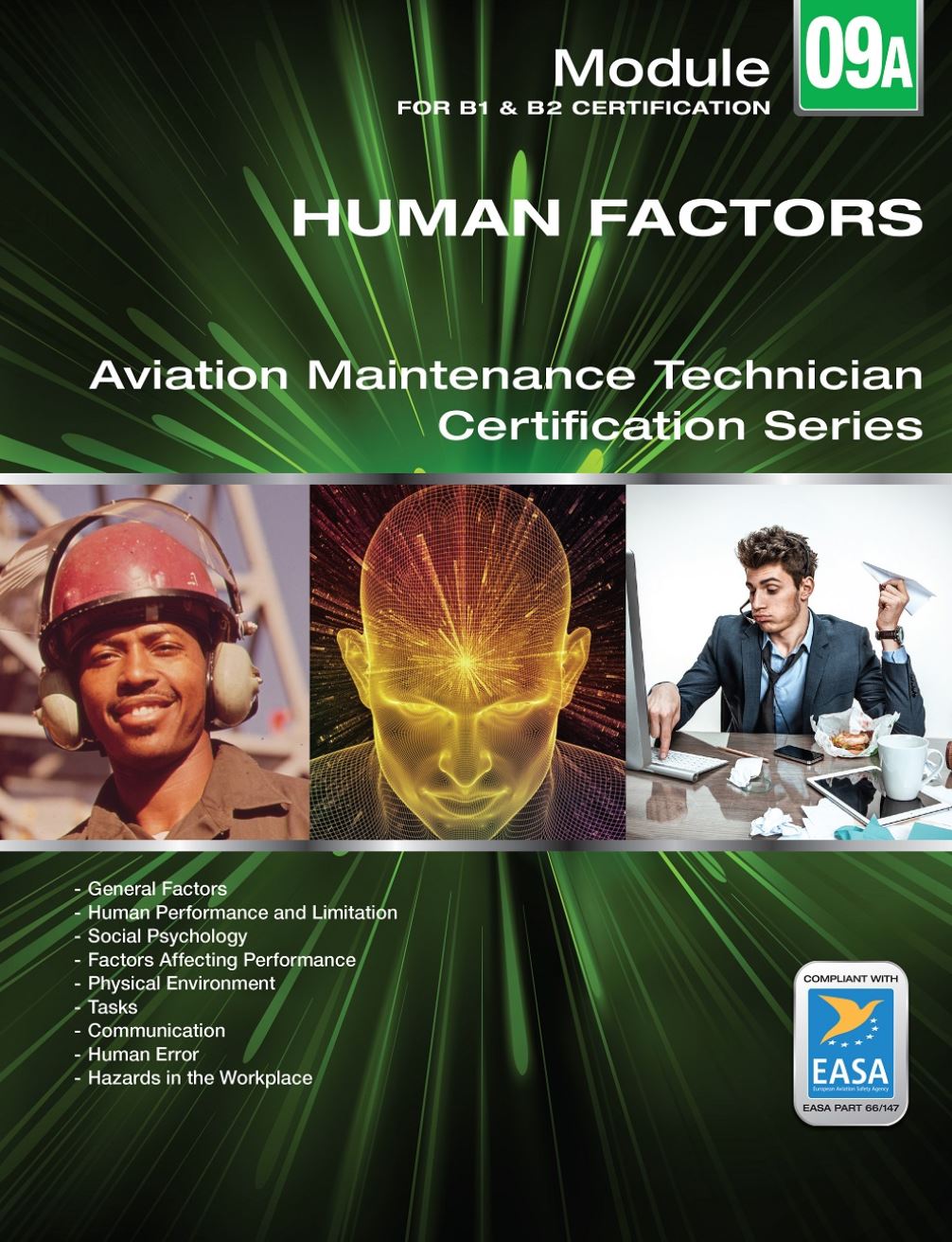
Module 9. Human factors
This module is required for all licences and is made up of 9 chapters, including human performance, social psychology, communication and hazards in the workplace.
There is no prerequisite for this module.
Module 9. Human Factors (EASA Part-66)
📘Contents:
9.1. General (level 2)
The need to consider human factors; incidents due to human error; Murphy’s law.
9.2. Human Performance and Limitations (level 2)
Vision, hearing, information processing, attention, perception, memory, claustrophobia and physical access.
9.3. Social Psychology (level 1)
Individual and group responsibility; motivation; peer pressure; culture; teamwork; management and leadership.
9.4. Factors Affecting Performance (level 2)
Health, stress, time pressure, workload, fatigue, shift work, alcohol and drugs.
9.5. Physical Environment (level 1)
Noise, fumes, lighting, temperature, vibration and working conditions.
9.6. Tasks (level 1)
Physical work, repetitive tasks, inspections and complex tasks.
9.7. Communication (level 2)
Team communication, documentation, information sharing and maintaining currency.
9.8. Human Error (level 2)
Error types, models, consequences and error management.
9.9. Hazards in the Workplace (level 2)
Hazard recognition, avoidance and emergency handling.
⚒ Performance: No
📝 Exam: Yes
📄 Certificate: No
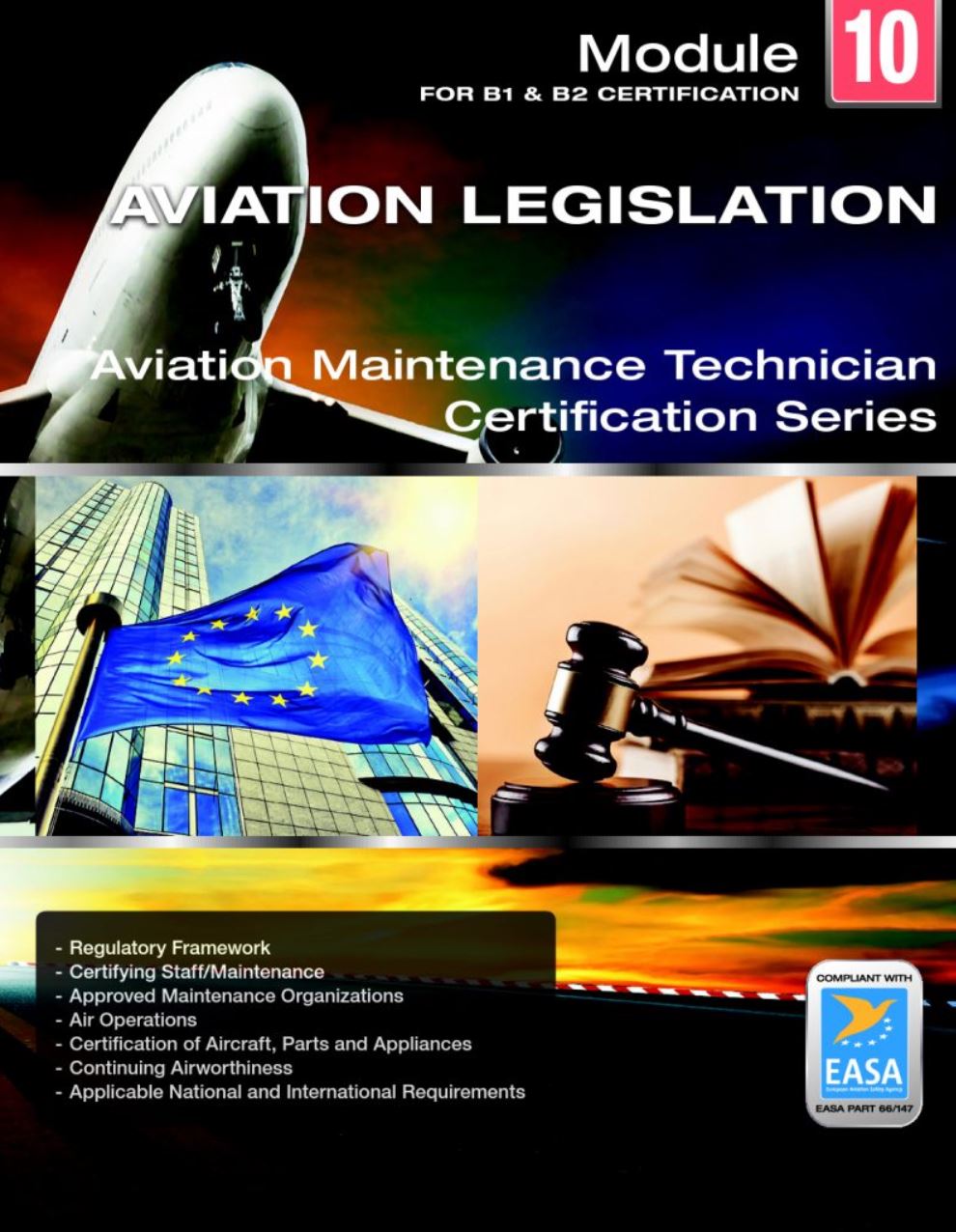
Module 10. Aviation legislation
This updated second edition module is required for all licences and is made up of 7 chapters, including certifying staff, aircraft certification and international requirements.
This module can be studied at any stage during your licence.
This subject is constantly changing and this second edition should be used in conjunction with EASA and CAA publications.
Module 10. Aviation Legislation (EASA Part-66)
📘Contents:
10.1. Regulatory Framework (level 1)
Role of ICAO, European Commission, EASA, Member States and National Aviation Authorities; Regulation (EC) No 216/2008; Regulations (EU) No 748/2012 and (EU) No 1321/2014; Relationship between Part-21, Part-M, Part-145, Part-66, Part-147 and Regulation (EU) No 965/2012.
10.2. Certifying Staff — Maintenance (level 2)
Detailed understanding of Part-66.
10.3. Approved Maintenance Organizations (level 2)
Detailed understanding of Part-145 and Part-M Subpart F.
10.4. Air Operations (level 1)
Understanding of Regulation (EU) No 965/2012; Air Operator Certificates; operator responsibilities; maintenance programme; MEL/CDL; onboard documents; aircraft markings.
10.5. Certification of Aircraft, Parts and Appliances
- General (level 1): Part-21 and EASA CS-23, 25, 27, 29
- Documents (level 2): Certificate of Airworthiness, permit to fly, registration, noise certificate, weight schedule, radio licence
10.6. Continuing Airworthiness (level 2)
Part-21 provisions and detailed understanding of Part-M.
10.7. National and International Requirements
- Maintenance programmes, inspections, Airworthiness Directives, Service Bulletins
- Modifications, repairs and maintenance documentation
- Continuing airworthiness; minimum equipment; ETOPS; test flights; all-weather operations
⚒ Performance: No
📝 Exam: Yes
📄 Certificate: No
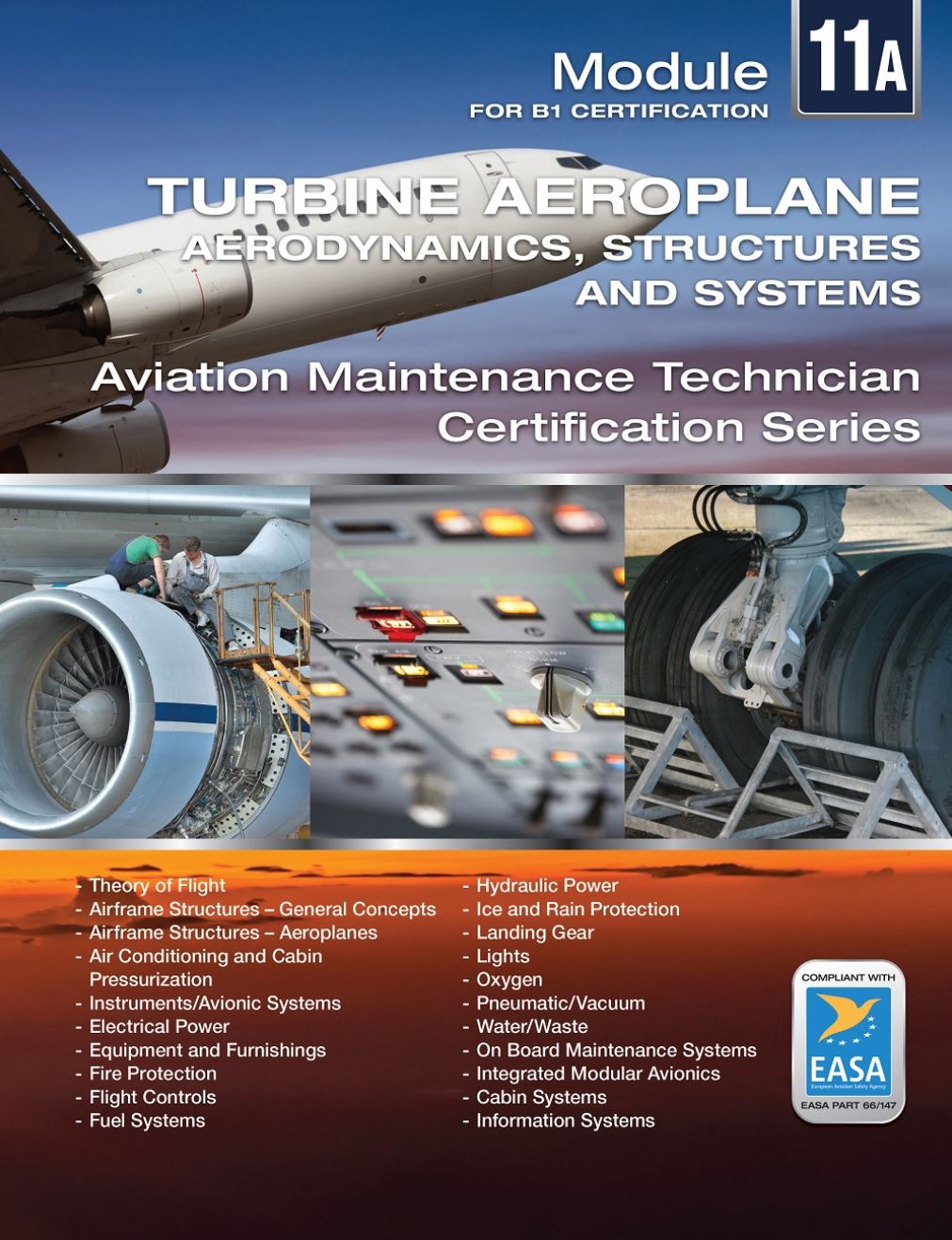
Module 11a. Aeroplane aerodynamics, structures and systems
This module is required for A1 and B1.1 licences only. It is a particularly large module consisting of 21 chapters.
The module covers Theory of Flight, airframe structures, air conditioning, instruments, power systems, lighting, and on-board maintenance systems.
It is recommended to have prior knowledge of Module 2: Physics, Module 3: Electrical Fundamentals, Module 5: Digital Techniques / Electronic Instrument Displays and Module 8: Basic Aerodynamics before studying this module.
Module 11a. Aeroplane Aerodynamics, Structures and Systems (EASA Part-66)
📘Contents:
11.1. Theory of Flight
- Aeroplane aerodynamics and flight controls
- High speed flight
11.2. Airframe Structures – General Concepts
- Structural strength and classification
- Construction methods and protection
11.3. Airframe Structures – Airplanes
- Fuselage
- Wings
- Stabilizers
- Flight control surfaces
- Nacelles / pylons
11.4. Air Conditioning and Cabin Pressurization (ATA 21)
- Air supply
- Air conditioning systems
- Pressurization
- Safety and warning devices
11.5. Instruments / Avionic Systems
- Instrument systems
- Avionic systems fundamentals
11.6. Electrical Power (ATA 24)
Generation, distribution, regulation and protection of electrical power.
11.7. Equipment and Furnishings (ATA 25)
Cabin layout, emergency equipment, furnishings and installations.
11.8. Fire Protection (ATA 26)
Fire detection, warning and extinguishing systems.
11.9. Flight Controls (ATA 27)
Primary and secondary controls, systems operation and protection.
11.10. Fuel Systems (ATA 28)
Fuel storage, supply, transfer, indication and refuelling systems.
11.11. Hydraulic Power (ATA 29)
Hydraulic systems, pressure generation, distribution and control.
11.12. Ice and Rain Protection (ATA 30)
Anti-icing and de-icing systems and operation.
11.13. Landing Gear (ATA 32)
Construction, extension/retraction, braking and steering.
11.14. Lights (ATA 33)
External and internal aircraft lighting systems.
11.15. Oxygen (ATA 35)
Oxygen systems, storage and distribution.
11.16. Pneumatic / Vacuum (ATA 36)
Pneumatic systems and interfaces.
11.17. Water / Waste (ATA 38)
Water supply and waste systems.
11.18. On Board Maintenance Systems (ATA 45)
Central maintenance and monitoring systems.
11.19. Integrated Modular Avionics (ATA 42)
IMA architecture and integrated aircraft functions.
11.20. Cabin Systems (ATA 44)
Passenger communication, entertainment and cabin network systems.
11.21. Information Systems (ATA 46)
Aircraft information storage, retrieval and management systems.
⚒ Performance: Yes
📝 Exam: Yes
📄 Certificate: Yes
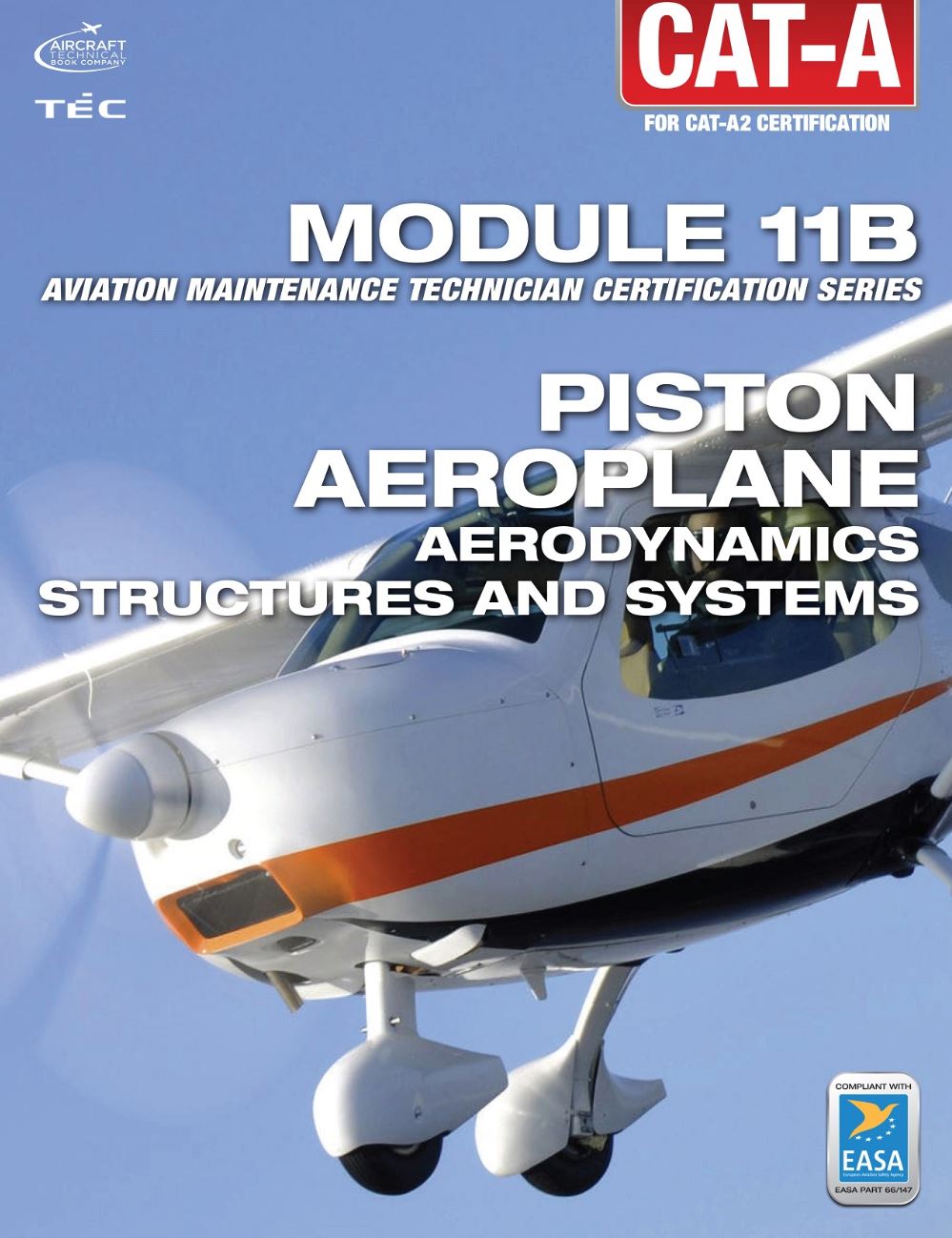
Module 11b. Aeroplane aerodynamics, structures and systems
This module is required for A2 and B1.2 licences only. It is a particularly large module consisting of 17 chapters.
The module covers Theory of Flight, airframe structures, air conditioning, instruments, power systems, lighting, and on-board maintenance systems.
It is recommended to have prior knowledge of Module 2: Physics, Module 3: Electrical Fundamentals, Module 5: Digital Techniques / Electronic Instrument Displays and Module 8: Basic Aerodynamics before studying this module.
Module 11b. Aeroplane Aerodynamics, Structures and Systems (EASA Part-66)
📘Contents:
11.1. Theory of Flight
- Aeroplane aerodynamics and flight controls
- High speed flight
11.2. Airframe Structures – General Concepts
- Structural strength, classification and fatigue concepts
- Construction methods, assembly and protection
11.3. Airframe Structures – Airplanes
- Fuselage
- Wings
- Stabilizers
- Flight control surfaces
- Nacelles / pylons
11.4. Air Conditioning and Cabin Pressurization (ATA 21)
- Air supply
- Air conditioning
- Pressurization
- Safety and warning devices
11.5. Instruments / Avionic Systems
- Instrument systems
- Avionic systems fundamentals
11.6. Electrical Power (ATA 24)
DC and AC generation, distribution, regulation and protection systems.
11.7. Equipment and Furnishings (ATA 25)
Emergency equipment, cabin layout, furnishings and installations.
11.8. Fire Protection (ATA 26)
Detection, warning and extinguishing systems.
11.9. Flight Controls (ATA 27)
Primary and secondary control systems, operation and protection.
11.10. Fuel Systems (ATA 28)
Fuel storage, supply, transfer and indication systems.
11.11. Hydraulic Power (ATA 29)
Hydraulic system layout, generation, control and distribution.
11.12. Ice and Rain Protection (ATA 30)
Anti-icing and de-icing systems.
11.13. Landing Gear (ATA 32)
Construction, extension, braking and steering systems.
11.14. Lights (ATA 33)
External and internal aircraft lighting.
11.15. Oxygen (ATA 35)
Oxygen storage, distribution and control systems.
11.16. Pneumatic / Vacuum (ATA 36)
Pneumatic system sources, control and distribution.
11.17. Water / Waste (ATA 38)
Water supply and waste systems.
11.18. On Board Maintenance Systems (ATA 45)
Central maintenance computers and monitoring systems.
11.19. Integrated Modular Avionics (ATA 42)
IMA systems and integrated aircraft functions.
11.20. Cabin Systems (ATA 44)
Cabin communication, entertainment and network systems.
11.21. Information Systems (ATA 46)
Aircraft information storage and management systems.
⚒ Performance: Yes
📝 Exam: Yes
📄 Certificate: Yes
Module 12. Helicopter aerodynamics, structures and systems
This module is required for A3, A4, B1.3 and B1.4 helicopter licences only. It is made up of 19 chapters, including theory of flight, airframe structures, air conditioning, instruments, power, lights and blade tracking.
It may be an advantage to have studied Module 2: Physics, Module 3: Electrical Fundamentals, Module 5: Digital Techniques / Electronic Instrument Displays and Module 8: Basic Aerodynamics before studying this module.
Module 12. Helicopter aerodynamics, structures and systems (EASA Part-66)
📘Contents:
12.1. Theory of Flight — Rotary Wing
- Rotor aerodynamics, lift generation
- Gyroscopic effects, vortex ring, autorotation
12.2. Flight Control Systems
- Cyclic, collective, tail rotor
- Swashplate and rotor head systems
12.3. Blade Tracking and Vibration
Rotor alignment, balancing, vibration analysis, ground resonance.
12.4. Transmission
Gearboxes, rotor drive systems, clutches, rotor brake.
12.5. Airframe Structures
Structural design, stress, fatigue, airworthiness concepts.
12.6. Air Conditioning (ATA 21)
Air supply, conditioning and distribution.
12.7. Instruments / Avionics
Instrument systems and avionics basics.
12.8. Electrical Power (ATA 24)
Generation, regulation and distribution.
12.9. Equipment and Furnishings (ATA 25)
Cabin layout and emergency equipment.
12.10. Fire Protection (ATA 26)
Detection and extinguishing systems.
12.11. Fuel Systems (ATA 28)
Fuel storage, supply and indication.
12.12. Hydraulic Power (ATA 29)
Hydraulic systems and control.
12.13. Ice and Rain Protection (ATA 30)
Anti-icing and de-icing systems.
12.14. Landing Gear (ATA 32)
Landing gear construction and operation.
12.15. Lights (ATA 33)
Aircraft lighting systems.
12.16. Pneumatic Systems (ATA 36)
Pressure systems and distribution.
12.17. Integrated Modular Avionics (ATA 42)
Integrated avionics systems.
12.18. On Board Maintenance Systems (ATA 45)
Monitoring and diagnostic systems.
12.19. Information Systems (ATA 46)
Data storage and aircraft information systems.
⚒ Performance: Yes
📝 Exam: Yes
📄 Certificate: Yes
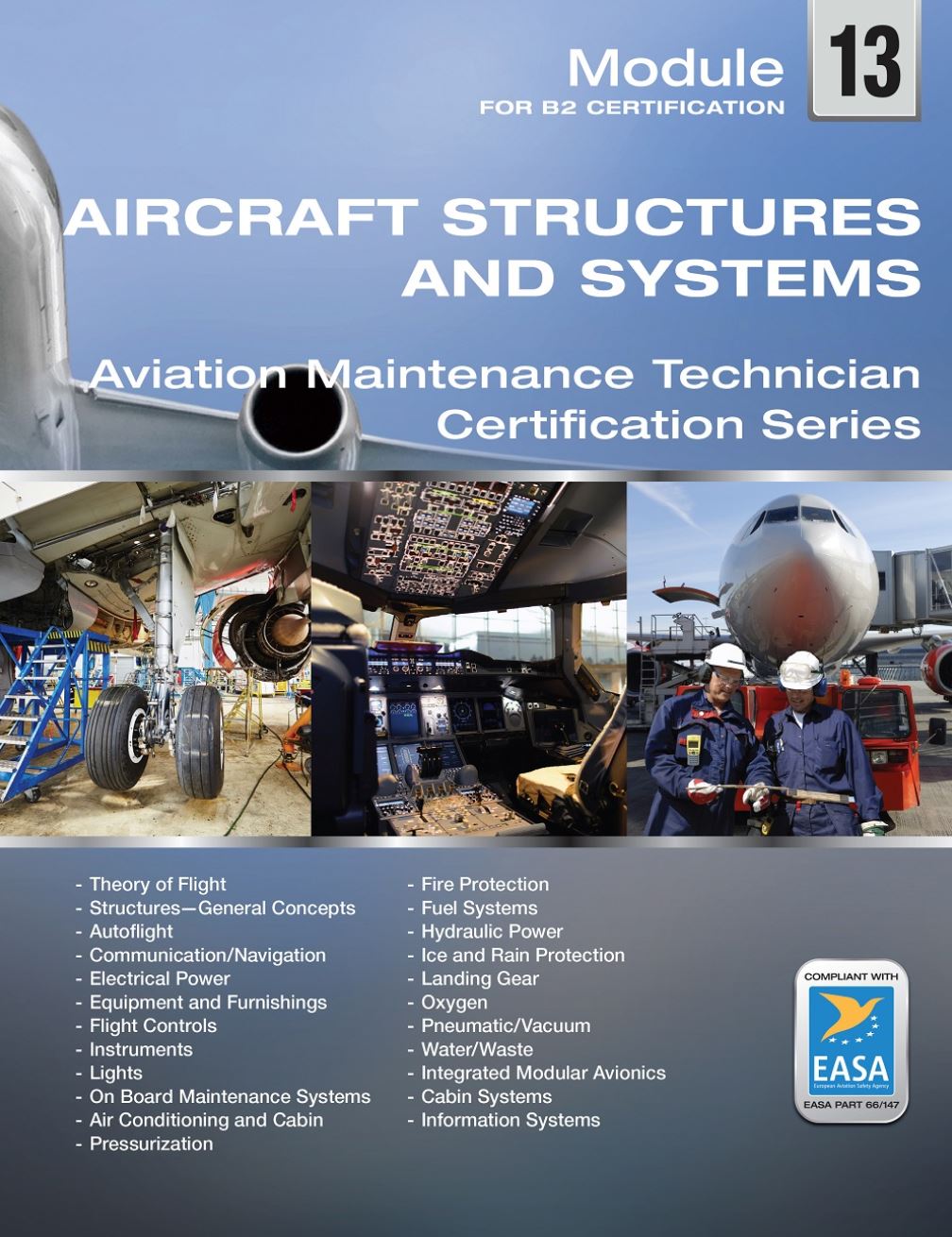
Module 13. Aircraft aerodynamics, structures and systems
This module is required for B2 licences only and is made up of 22 chapters.
This module includes Theory of Flight, structures, instruments, power, lights and on-board maintenance systems.
It may be an advantage to have studied Module 2: Physics, Module 3: Electrical Fundamentals, Module 5: Digital Techniques / Electronic Instrument Displays and Module 8: Basic Aerodynamics before studying this module.
Module 13. Aircraft aerodynamics, structures and systems (EASA Part-66)
📘Contents:
13.1. Theory of Flight
- Aeroplane aerodynamics and flight controls
- High speed flight
13.2. Airframe Structures
Structural concepts, strength, fatigue, bonding and protection.
13.3. Autoflight Systems (ATA 22)
Autopilot, flight director, autothrottle systems.
13.4. Communication & Navigation (ATA 23/34)
VHF, HF, GPS, ILS, VOR, DME, data link systems.
13.5. Electrical Power (ATA 24)
Generation, distribution, protection and conversion systems.
13.6. Equipment and Furnishings (ATA 25)
Cabin systems, emergency equipment and installations.
13.7. Flight Controls (ATA 27)
Primary and secondary control systems and fly-by-wire.
13.8. Instruments (ATA 31)
Flight instruments, displays and monitoring systems.
13.9. Lights (ATA 33)
External and internal lighting systems.
13.10. Onboard Maintenance Systems (ATA 45)
Central maintenance computers and diagnostics.
13.11. Air Conditioning & Pressurization (ATA 21)
Air supply, conditioning and cabin pressure systems.
13.12. Fire Protection (ATA 26)
Detection and extinguishing systems.
13.13. Fuel Systems (ATA 28)
Fuel storage, transfer, control and indication.
13.14. Hydraulic Power (ATA 29)
Hydraulic generation, distribution and control.
13.15. Ice and Rain Protection (ATA 30)
Anti-icing and de-icing systems.
13.16. Landing Gear (ATA 32)
Extension, braking, steering and monitoring.
13.17. Oxygen Systems (ATA 35)
Storage, distribution and regulation.
13.18. Pneumatic / Vacuum (ATA 36)
Air systems and pressure distribution.
13.19. Water / Waste (ATA 38)
Water supply and waste systems.
13.20. Integrated Modular Avionics (ATA 42)
IMA architecture and integrated avionics functions.
13.21. Cabin Systems (ATA 44)
Passenger communication, entertainment and network systems.
13.22. Information Systems (ATA 46)
Aircraft data storage, processing and retrieval systems.
⚒ Performance: Yes
📝 Exam: Yes
📄 Certificate: Yes
Module 14. Propulsion
This module is for engineers studying for the B2 licence only.
It consists of 3 chapters, covering turbine engines and engine indicating systems.
It explains the basic operation of several types of gas turbine engine as well as the operation of various engine indicating systems.
Module 14. Propulsion (EASA Part-66)
📘Contents:
14.1. Engines
- Turbine engines: turbojet, turbofan, turboprop, turboshaft
- Basic engine construction and operation
- Auxiliary Power Unit (APU)
- Engine control systems (FADEC, fuel metering)
14.2. Engine Indicating Systems
- Engine temperature systems (EGT, ITT)
- Engine speed indication (N1, N2)
- Thrust indication (EPR, pressure systems)
- Oil pressure and temperature
- Fuel flow, pressure and temperature
- Torque and propeller speed indication
14.3. Propeller Systems
- Propeller types and construction
- Pitch control systems
- Constant speed units
- Propeller synchronization and protection
14.4. Starting and Ignition Systems
- Starting systems: electric, pneumatic, hydraulic, APU
- Engine start sequence and control
- Ignition systems and igniters
- Safety procedures and maintenance requirements
⚒ Performance: Yes
📝 Exam: Yes
📄 Certificate: Yes
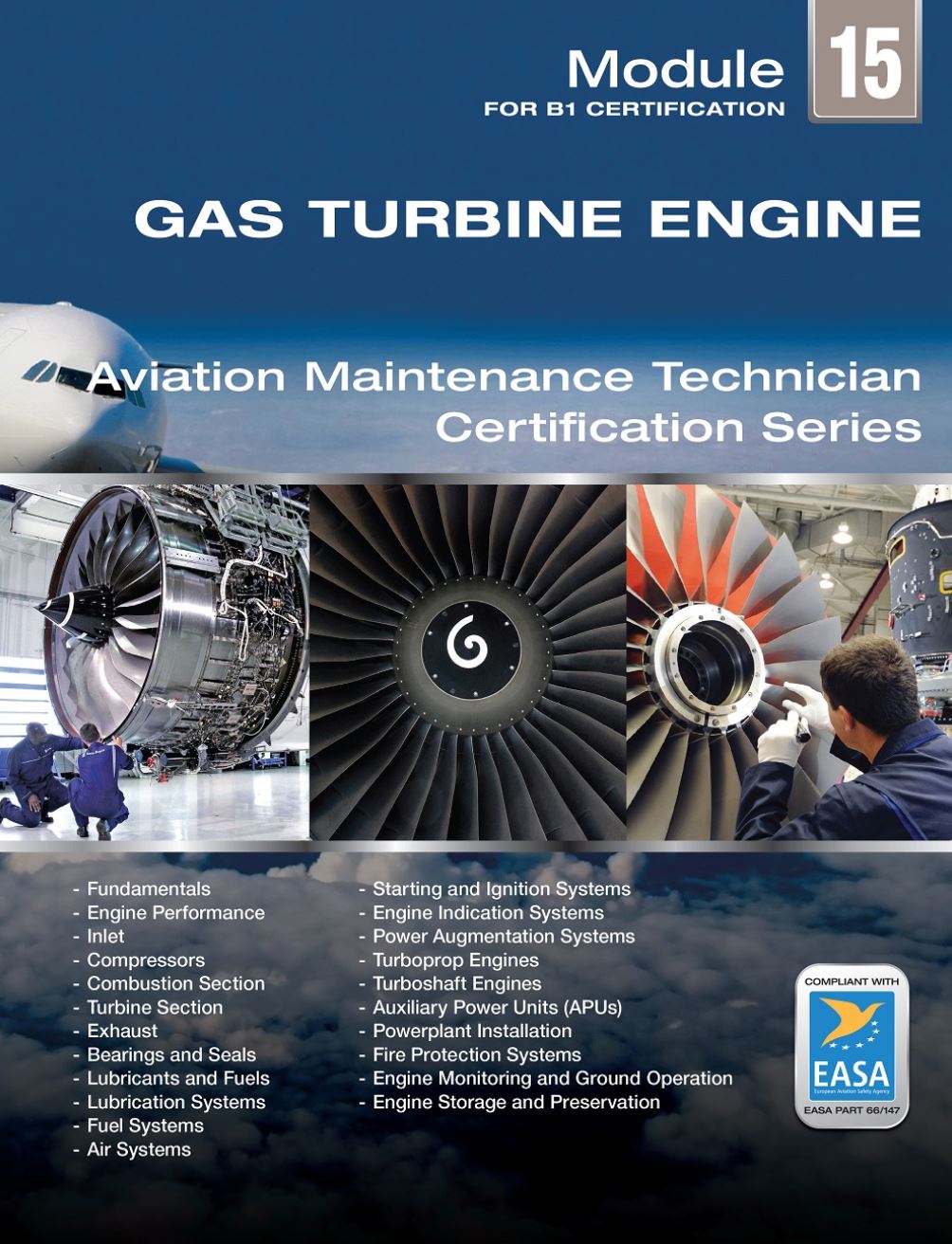
Module 15. Gas turbine engine
This module is for engineers studying for the A1, A3, B1.1 and B1.3 licences, working on gas turbine engine aircraft.
All 22 chapters of the syllabus are covered.
Engine fundamentals are covered before looking into each part of the engine in detail.
Several types of gas turbine engine are considered, and the module finishes with the installation, monitoring, storage and preservation of gas turbine engines.
Module 15. Gas Turbine Engine (EASA Part-66)
📘Contents:
15.1–15.2. Fundamentals & Performance
- Energy, Newton’s laws, Brayton cycle
- Thrust, efficiency, engine ratings, environmental effects
15.3–15.7. Engine Core Sections
- Inlet systems and icing
- Compressors (axial, centrifugal, stall/surge control)
- Combustion section
- Turbine section (stress, creep)
- Exhaust systems, noise reduction, thrust reversers
15.8–15.12. Supporting Systems
- Bearings and seals
- Lubricants, fuels and safety
- Lubrication systems
- Fuel systems and FADEC
- Air systems (cooling, sealing, anti-ice)
15.13–15.14. Starting & Indication
- Engine starting systems and ignition
- Engine indication: EGT, N1/N2, oil, fuel, vibration, torque
15.15–15.18. Engine Types & Auxiliary Systems
- Power augmentation (afterburner, water injection)
- Turboprop engines
- Turboshaft engines
- Auxiliary Power Units (APU)
15.19–15.20. Installation & Fire Protection
- Powerplant installation and mounting
- Fire detection and extinguishing systems
15.21–15.22. Operation & Preservation
- Engine monitoring, ground operation, maintenance checks
- Engine storage and preservation
⚒ Performance: Yes
📝 Exam: Yes
📄 Certificate: Yes
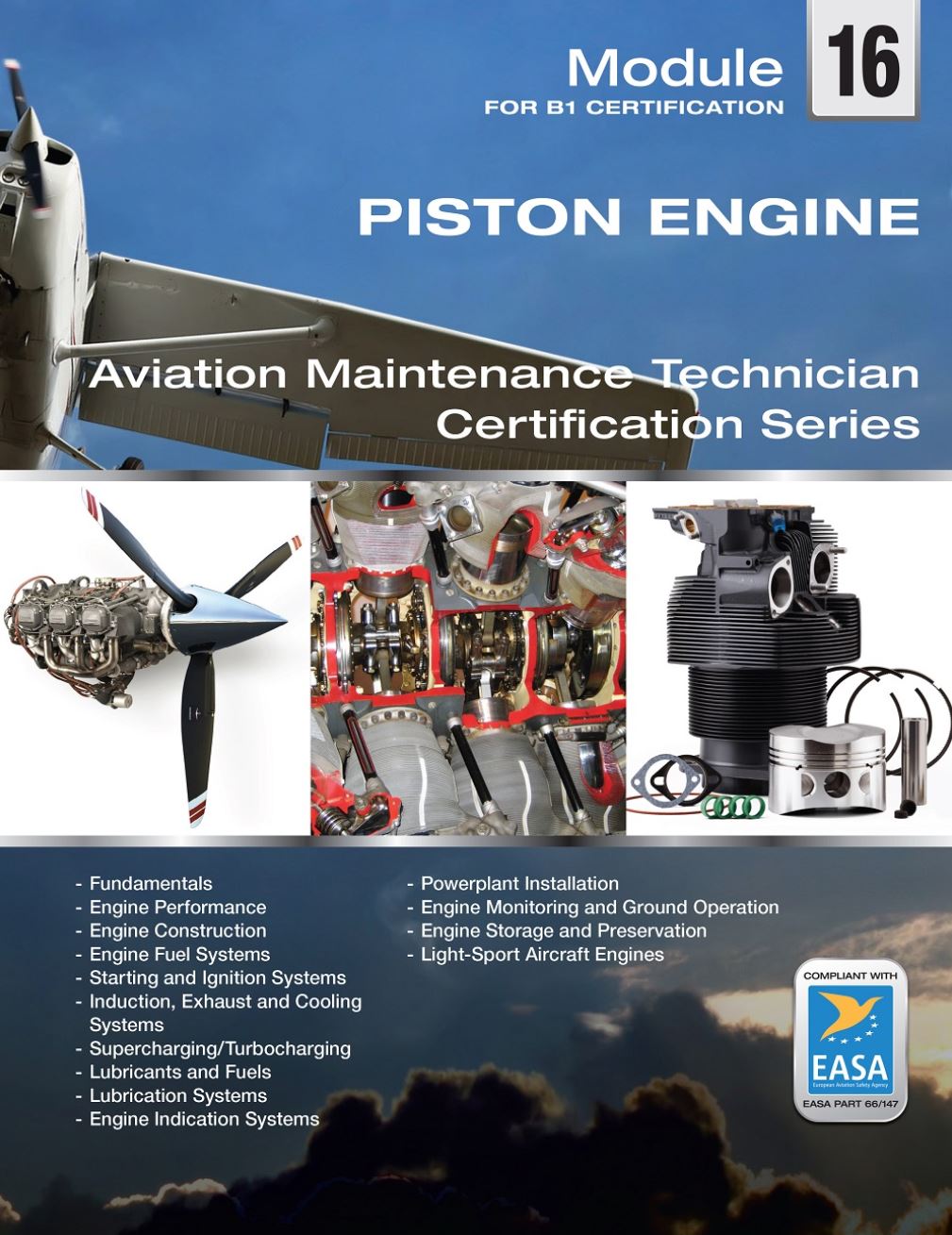
Module 16. Piston engine
This module is for engineers studying for the A2, A4, B1.2 and B1.4 licences, working on piston engine aircraft.
All 13 chapters of the syllabus are covered.
Engine fundamentals are covered before examining each part of the engine in detail.
The module includes fuel systems, turbocharging, and concludes with installation, monitoring, storage and preservation of piston engines.
Module 16. Piston Engine (EASA Part-66)
📘Contents:
16.1. Fundamentals
- Mechanical, thermal and volumetric efficiencies
- 2-stroke, 4-stroke, Otto and Diesel cycles
- Piston displacement and compression ratio
16.2. Engine Performance
Power output, efficiency, mixture control, pre-ignition and detonation.
16.3. Engine Construction
Crankcase, crankshaft, pistons, valves, camshaft, accessory gearbox.
16.4. Engine Fuel Systems
- Carburettors and icing
- Fuel injection systems
- Electronic engine control (FADEC)
16.5. Starting and Ignition Systems
Magnetos, spark plugs, ignition systems and starting methods.
16.6. Induction, Exhaust and Cooling
Air intake, exhaust systems and engine cooling (air/liquid).
16.7. Supercharging / Turbocharging
Boost systems, control, protection and performance effects.
16.8. Lubricants and Fuels
Properties, specifications, additives and safety.
16.9. Lubrication Systems
Oil systems, components and operation.
16.10. Engine Indication Systems
RPM, temperatures, pressures, fuel flow, manifold pressure.
16.11. Powerplant Installation
Engine mounting, vibration isolation, connections and structures.
16.12. Engine Monitoring and Ground Operation
Start procedures, run-up, inspections and parameter monitoring.
16.13. Engine Storage and Preservation
Preservation and depreservation procedures.
16.14. Alternative Engine Constructions
Advanced and hybrid piston engine concepts.
⚒ Performance: Yes
📝 Exam: Yes
📄 Certificate: Yes
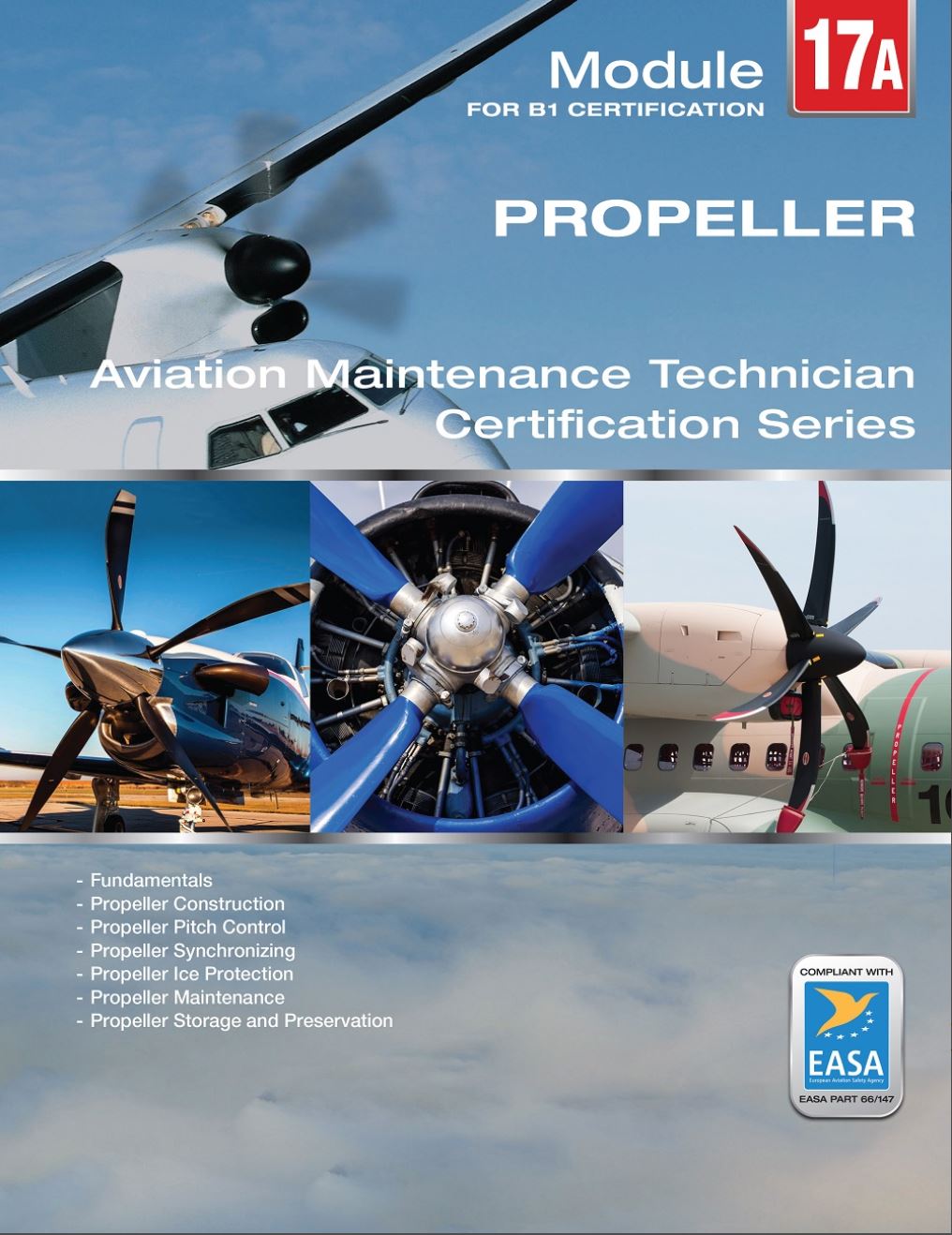
Module 17. Propeller
This module is for engineers studying for the A1, A2, B1.1 and B1.2 licences, working on gas turbine or piston engine aeroplanes.
All 7 chapters of the syllabus are covered, including fundamentals, propeller construction, propeller pitch control, propeller synchronising, propeller ice protection, propeller maintenance and storage & preservation.
Module 17. Propeller (EASA Part-66)
📘Contents:
17.1. Fundamentals (level 2)
- Blade element theory, blade angles, angle of attack
- Slip, rotational speed, airflow and forces
- Torque, vibration and resonance
17.2. Propeller Construction (level 2)
Materials and construction of wooden, composite and metal propellers; blade geometry; hub assembly; fixed and variable pitch systems.
17.3. Propeller Pitch Control (level 2)
Mechanical and electronic pitch control; feathering, reverse pitch and overspeed protection.
17.4. Propeller Synchronizing (level 2)
Synchronising and synchrophasing systems.
17.5. Propeller Ice Protection (level 2)
Fluid and electrical de-icing systems.
17.6. Propeller Maintenance (level 3)
- Static and dynamic balancing
- Blade tracking
- Damage assessment: erosion, corrosion, impact, delamination
- Repair schemes and engine run procedures
17.7. Propeller Storage and Preservation (level 2)
Preservation and depreservation procedures.
⚒ Performance: Yes
📝 Exam: Yes
📄 Certificate: Yes
B1 Limitation Removal
This module covers Module 7.7 and the part of Module 11 required to remove limitations from B1 licence.